
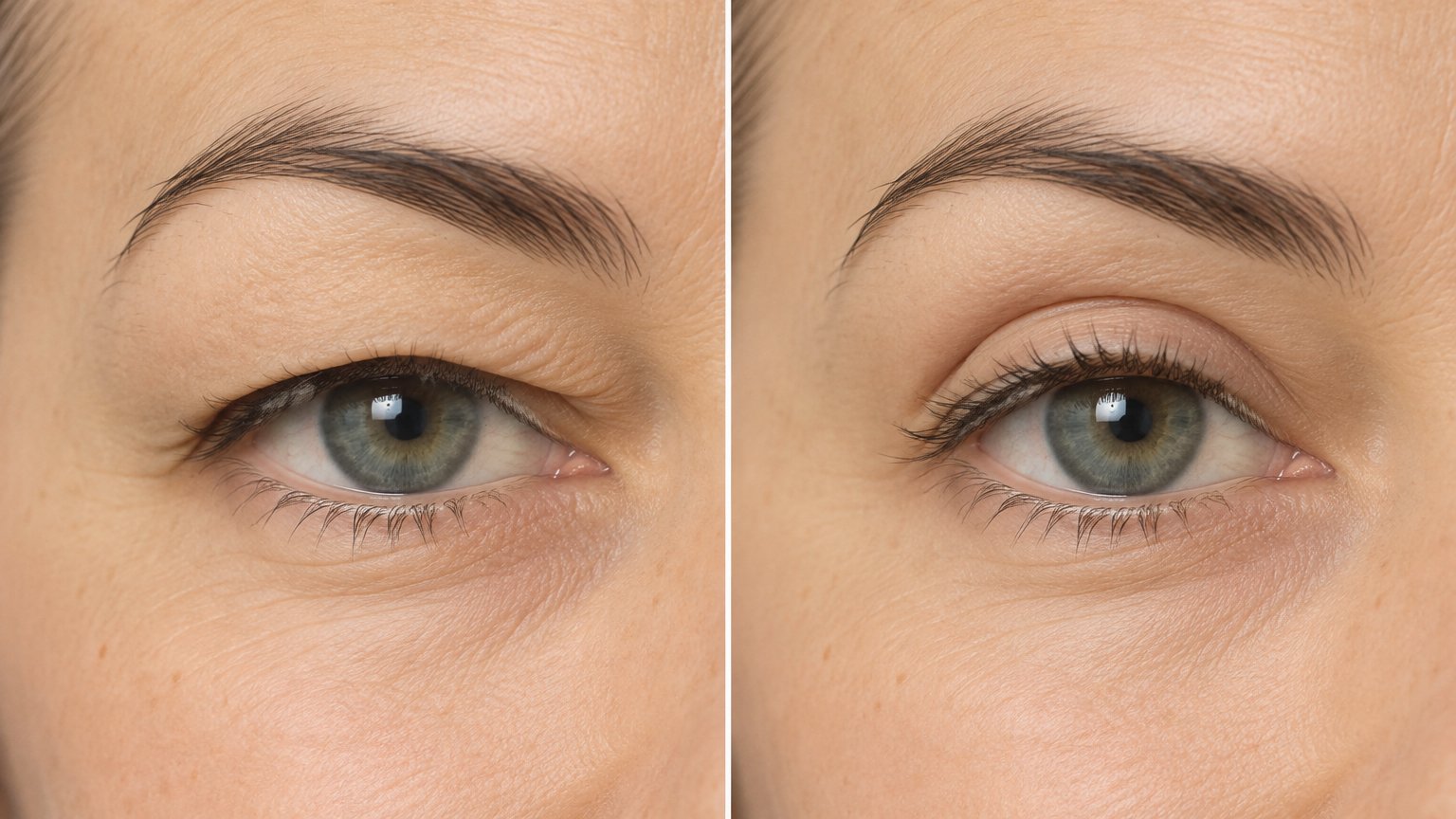
1At a glance
- Procedure time
- About 1 hour
- Anaesthesia
- Local anaesthetic, with sedation if preferred
- Going home
- Home the same day
- Garment / dressing
- Steri-Strips on the incision — you can remove them from day 3; then ointment
- Stitches
- Removed at days 5–7
- Back to work
- 7–10 days
- Exercise
- Walking from day 1; gym after 3 weeks
2Before your surgery
Specific to this procedure
- Bring your sunglasses for the journey home and glasses instead of contact lenses.
- Stop eyelash serums, retinol and eye creams around the eyes 1 week before.
- If you have dry eyes or use eye drops, tell us — we may give you lubricating drops to start in advance.
- If you choose sedation, follow the fasting and escort rules for anaesthesia.
Preparing for surgery
In the week before
- Stop aspirin, ibuprofen and blood-thinning supplements (fish oil, vitamin E, ginkgo, garlic, turmeric) 7 days before, unless a doctor prescribed them for your heart — then ask us first. Paracetamol is fine.
- Avoid alcohol for 48 hours before, and cut down on smoking as much as you can.
- Tell us about your medicines, allergies, and any history of cold sores, keloid scars or easy bruising.
- Let us know if you develop a fever or a skin infection in the treatment area.
On the day
- Eat a light meal beforehand — this procedure is done under local anaesthetic, so you do not need to fast unless we tell you otherwise.
- Arrive with clean skin: no make-up, creams or self-tan on the area.
- Wear comfortable clothes that are easy to take on and off over the treated area.
3After your surgery
Your medicines
- Augmentin (antibiotic): 1 tablet twice a day, with food, for 7 days. Finish the full course even if you feel well. Tell us before surgery if you are allergic to penicillin.
- Reparil (for swelling and bruising): 2 tablets three times a day for 7–14 days, as we tell you.
- Brufen (painkiller): take it only when you need it, with food. If you cannot take anti-inflammatory painkillers — for example because of stomach ulcers, kidney problems or asthma — tell us and we will give you an alternative.
- Tobradex eye ointment: once a day, before sleep, inside the eye — gently pull the lower lid down and apply a thin line. From day 3, after you remove the Steri-Strips, also apply it on the wound.
- Tobradex eye drops: 1 drop 3–4 times a day.
- After the first week, stop Tobradex (ointment and drops) and use only lubricating eye drops, such as Artelac Advanced, whenever your eyes feel dry.
- Then, once the wound has healed, apply a silicone scar gel with UV protection, such as NewGel+ UV, on the scar twice a day.
First 48 hours
- Leave the Steri-Strips (thin tapes on the eyelid crease) in place and keep them dry.
- Do not put cold or hot compresses on the eyes.
- Sleep and rest with your head raised on 2 pillows for the first week.
- Your vision may be slightly blurred from the ointment — this is normal. Rest your eyes; limit screens and reading for the first 2–3 days.
Eye and wound care
- From day 3 you can remove the Steri-Strips yourself: peel each one off slowly and gently, from the outer end towards the nose.
- Once the strips are off, apply Tobradex eye ointment along the wound as well (see Your medicines). There is no need to wash or clean the wound with water.
- Use your eye drops as listed in Your medicines — the eyes can feel dry or gritty for a couple of weeks.
- Do not rub your eyes. Pat, never pull.
- You may shower from day 2, keeping your face and eyes out of the water stream.
Daily life
- No contact lenses for 2 weeks and no eye make-up for 2 weeks (or until we say the wound has healed). Use new eye make-up products when you restart.
- Wear sunglasses outdoors; avoid dust, wind and swimming pools for 2 weeks.
- Avoid bending, heavy lifting and strenuous exercise for 2 weeks.
- Do not drive until your vision is clear and you are off any sedating medicines.
4Your recovery, week by week
- Day 1–3Most swelling and bruising. Eyelids feel tight; some watering or dryness. Steri-Strips can come off from day 3; ointment starts.
- Day 5–7Stitches removed. Bruising fading.
- Day 10–14Most people return to work and social life; eye make-up and lenses can usually restart.
- Weeks 4–6Scar softens and becomes pale pink.
- Months 3–6Scar fades into the crease; final result.
5Follow-up visits
- 1 week after your procedure
- 3 weeks after your procedure
- 6 weeks after your procedure
Call us straight away if you notice
Sudden severe eye pain, a bulging eye, or any loss or change of vision — this is an emergency; call us immediately.
Swelling that rapidly increases on one side, with tightness behind the eye.
A temperature of 38 °C or higher, shivering, or feeling generally unwell.
Bleeding that soaks through the dressing, or does not stop after 10 minutes of firm pressure.
Swelling that is sudden, tense and painful, or clearly larger on one side than the other.
Redness that is spreading, increasing heat, pus, or a bad smell from a wound.
Pain that is getting worse rather than better, or not controlled by the medicine we gave you.
Pain, swelling or redness in a calf, or new breathlessness or chest pain — call 998 first.
Chest pain, difficulty breathing, or heavy bleeding that will not stop: call 998 (ambulance) or go to the nearest emergency department, then let us know.
Questions while you recover
Message or call the clinic any time — no question is too small, and it is always better to ask early.
Questions while you recover — Message or call the clinic any time — no question is too small, and it is always better to ask early. +971 50 108 8378 (WhatsApp) · info@eyas.doctor
This guide gives general advice. Dr. Eyas may give you instructions made just for you — at your consultation or when you go home after surgery. If his instructions are different from this guide, follow his instructions. If you are not sure, message us. Last reviewed: November 2026.