
1At a glance
- Procedure time
- 2–3 hours
- Anaesthesia
- General anaesthesia
- Going home
- Usually 1 night
- Garment / dressing
- Abdominal binder or garment 24/7 for 6 weeks
- Stitches
- Mostly dissolvable; drains (if used) out at 3–7 days
- Back to work
- 2–3 weeks
- Exercise
- Walking from day 1; light gym at 6 weeks; core training at 8–12 weeks
2Before your surgery
Specific to this procedure
- Stopping all nicotine for 4 weeks before is essential — it is the main cause of wound breakdown after a tummy tuck.
- Reach a stable weight you can keep; future pregnancy or major weight change can affect the result.
- Set up a recliner or a stack of pillows, and a chair you can get out of without using your stomach muscles.
- We may prescribe blood-thinning injections or stockings after surgery to prevent clots — we will show you how to use them.
Preparing for surgery
2–4 weeks before
- Stop smoking and all nicotine — cigarettes, vapes, shisha, patches and gum — at least 4 weeks before and 4 weeks after surgery. Nicotine narrows the small blood vessels that heal your wounds and is the commonest cause of wound breakdown.
- Complete the blood tests, ECG or other checks we request, and bring any recent results you already have.
- Tell us about every medicine, supplement and herbal product you take, any allergies, and any previous anaesthetic problems.
- If you take the contraceptive pill, hormone therapy, or weight-loss injections (such as Ozempic, Wegovy or Mounjaro), tell us early — some need to be paused before anaesthesia, and we will tell you exactly when.
- Arrange time off work and help at home for the first days, especially if you look after young children.
10 days before
- Stop aspirin, ibuprofen and other anti-inflammatory painkillers, and supplements that thin the blood: fish oil / omega-3, vitamin E, ginkgo, garlic, ginseng and turmeric. Paracetamol is fine.
- Do not stop any prescribed blood thinner (warfarin, apixaban, clopidogrel and similar) on your own — we will plan this with you and your doctor.
- Avoid alcohol from one week before surgery.
- Let us know straight away if you develop a cold, fever, cough, cold sore or any skin infection — surgery may need to move to keep you safe.
The day before
- Nothing to eat for 6 hours before your admission time. You may drink plain water until 2 hours before, unless we give you different times.
- Take your usual morning medicines with a sip of water only if we have told you to.
- Prepare your recovery space: extra pillows, loose front-opening clothes, water bottle, phone charger within reach.
- Arrange an adult to drive you home and stay with you for the first 24 hours. You must not drive or take a taxi alone after anaesthesia or sedation.
On the day
- Shower and wash your hair. Do not apply body lotion, make-up, false lashes, nail polish, fake tan, perfume or deodorant.
- Remove jewellery and piercings; leave valuables at home. Wear glasses rather than contact lenses.
- Wear loose, comfortable clothes that open at the front and flat shoes.
- Bring your ID, your list of medicines, and your compression garment if we asked you to buy one.
3After your surgery
Your medicines
- Augmentin (antibiotic): 1 tablet twice a day, with food, for 7 days. Finish the full course even if you feel well. Tell us before surgery if you are allergic to penicillin.
- Reparil (for swelling and bruising): 2 tablets three times a day for 7–14 days, as we tell you.
- Brufen (painkiller): take it only when you need it, with food. If you cannot take anti-inflammatory painkillers — for example because of stomach ulcers, kidney problems or asthma — tell us and we will give you an alternative.
- Fusidic acid cream (antibiotic cream): apply a thin layer on the wounds twice a day, after showering, until they have healed.
First week
- Walk slightly bent forward at the hips for the first 7–10 days to take tension off the wound, straightening gradually as it feels comfortable.
- Rest with your back raised and a pillow under your knees, in a 'beach chair' position — including at night.
- Get up and walk every 1–2 hours while awake. Circle your ankles and breathe deeply 10 times every hour.
- To get out of bed, roll to your side and push up with your arms — do not sit straight up.
- If you have drains, empty and record them twice daily; they come out when the output is low.
The wound
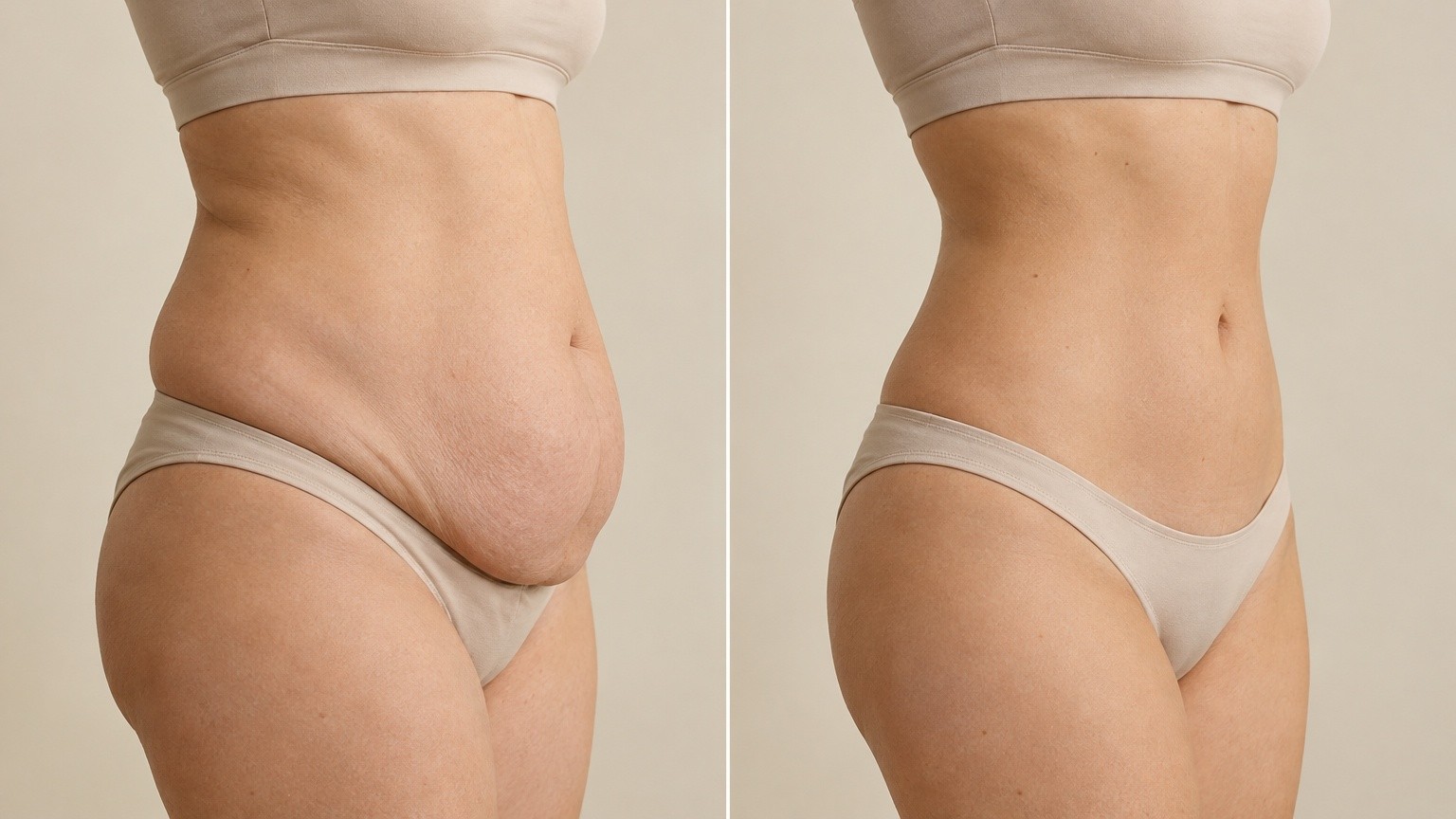
- The scar runs low across your abdomen, usually hidden by underwear, with a small second scar around the belly button.
- Keep the tapes or dressings on and dry; we check and change them at your follow-up visits. You may shower from 48 hours (or when drains allow) and pat dry.
- Once the dressings are off, apply fusidic acid cream on the wound twice a day until it has healed.
- Small scabs or slow-healing spots — most often in the middle of the scar or around the belly button — are common in the first weeks. Keep them clean and dry and we will dress them with you.
- Numbness of the lower abdomen is normal and can take months to improve — avoid hot water bottles and heat pads on it.
- No baths, pools or saunas for 4–6 weeks.
Scars
- Once the wound has fully healed (usually around 3 weeks), start silicone scar tapes. Wear them day and night, taking them off only to wash, for at least 3 months.
- Scars are pink and firm at first, then soften and fade gradually over 12–18 months.
- Keep scars out of the sun for at least a year — sun makes them darker. Cover them, or use SPF 50 once they have healed.
Binder and protecting the muscle repair
- Wear the binder or garment day and night for 6 weeks, off only to shower.
- No lifting more than 5 kg for 6 weeks — including children and shopping bags.
- Avoid sit-ups, crunches, planks and twisting for at least 8–12 weeks.
- Prevent constipation: drink well, eat fibre, and use the gentle laxative we give you. Avoid straining.
- Hold a pillow against your tummy when you cough, sneeze or laugh.
4Your recovery, week by week
- Day 1–3Most discomfort; walking bent forward; drains in.
- Week 1Drains usually out; first check.
- Weeks 2–3Standing straighter; back to desk work; driving once you can brake hard without pain.
- Week 6Binder off, light gym and swimming.
- Months 3–12Core training; swelling settles and the scar flattens and fades.
5Follow-up visits
- 4 days after your procedure
- 2 weeks after your procedure
- 29 days after your procedure
- 6 weeks after your procedure
Call us straight away if you notice
The skin of the lower abdomen becoming dark, blistered or cold.
Fluid swelling above the scar that sloshes or is growing (seroma) — we can drain it easily in the clinic.
A temperature of 38 °C or higher, shivering, or feeling generally unwell.
Bleeding that soaks through the dressing, or does not stop after 10 minutes of firm pressure.
Swelling that is sudden, tense and painful, or clearly larger on one side than the other.
Redness that is spreading, increasing heat, pus, or a bad smell from a wound.
Pain that is getting worse rather than better, or not controlled by the medicine we gave you.
Pain, swelling or redness in a calf, or new breathlessness or chest pain — call 998 first.
Chest pain, difficulty breathing, or heavy bleeding that will not stop: call 998 (ambulance) or go to the nearest emergency department, then let us know.
Questions while you recover
Message or call the clinic any time — no question is too small, and it is always better to ask early.
Questions while you recover — Message or call the clinic any time — no question is too small, and it is always better to ask early. +971 50 108 8378 (WhatsApp) · info@eyas.doctor
This guide gives general advice. Dr. Eyas may give you instructions made just for you — at your consultation or when you go home after surgery. If his instructions are different from this guide, follow his instructions. If you are not sure, message us. Last reviewed: November 2026.